
Cycles Of The Great Reset
 by Greg Reese
 Part I: The Rhythm of the Earth: Understanding the Great Reset and Catastrophic Crustal Shifts
There is a peculiar stillness to the Arctic, a place where the modern world feels distant and the secrets of the planet’s deep past seem more accessible. In the late 1940s, a mission known as Project Nanuk – conducted by the Strategic Air Command – began a systematic study of this frozen frontier. What they discovered was far from a static wasteland; rather, they found that the magnetic north pole was in motion, traveling roughly ten meters per year and accelerating at an exponential rate. After the data was analyzed by organizations like the OSS and the Rand Corporation, a heavy veil of silence was pulled over the findings. The consensus at the time was that revealing such a fundamental shift in the Earth’s stability would destroy the moral fiber of society, so the information remained private.
This discovery served as a catalyst for a deeper investigation into how our world actually functions. Within the same research networks, Charles Hapgood emerged as a leading figure in geoscience, producing what is now known as the crustal displacement theory. Hapgood’s work attempted to solve several lingering geological mysteries: how Antarctica could have once enjoyed a temperate climate, why the Sahara was previously a lush, green landscape, and how mammoths could be found flash-frozen with undigested tropical plants still in their stomachs. The explanation proposed was as simple as it was terrifying – the Earth’s entire outer shell can shift rapidly and catastrophically.
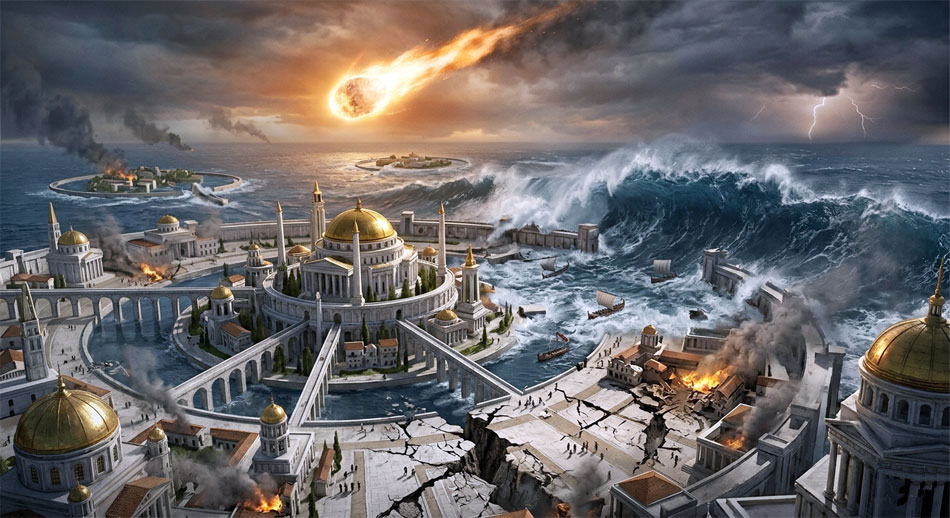
In 1965, an aerospace engineer named Chan Thomas, who had worked for McDonnell Douglas, published a geological study titled The Adam and Eve Story. Shortly after its release, the CIA classified the book, removing it from public reach. It was only through a Freedom of Information Act request that a sanitized, 57-page version was eventually released to the public. These pages describe a harrowing sequence of events: a crustal shift that completes its movement in a window of just six to twelve hours.
When the Earth’s crust moves with such suddenness, the atmosphere and the oceans cannot immediately follow. This results in the generation of supersonic winds and massive walls of ocean water, some reaching depths of two miles, sweeping across the continents. To many, this sounds like the stuff of myth, yet the “flood myth” appears in more than 200 independent cultural traditions across the globe. Researchers like Emanuel Velikovsky have hypothesized that these mythologies are not mere metaphors or religious allegories, but are actually eyewitness accounts of real catastrophic events that took place within recorded human history.
There is a growing body of evidence suggesting that these resets are not random but cyclical. The historical and geological records point toward a pattern where civilization is reset approximately every 12,000 years. One of the most significant markers of this cycle is the Younger Dryas impact theory, which suggests a comet struck the Earth around 13,000 years ago. This event wiped out numerous animal species and triggered a mini-ice age that gripped the planet for over a millennium.
As we look at ancient structures, the timeline of the 12,000-year cycle becomes even more compelling. Consider Göbekli Tepe, a site built about 11,600 years ago. The engineering precision required to construct it is something that modern archaeologists still struggle to explain. Similarly, the Great Sphinx in Egypt exhibits signs of water erosion caused by heavy rainfall – weather patterns that haven’t existed in that region for at least 10,000 years. Even more baffling is the Piri Reis map, drawn in 1513, which accurately depicts the coastline of Antarctica as it exists beneath the ice – a feat that suggests knowledge from a time before the continent was frozen over.
While the evidence for the cycle is visible, the “how” remains a subject of intense debate. Wallace Thornhill and David Talbott have developed the Electric Universe theory, which posits that plasma is the fourth state of matter and constitutes 99.9% of the visible universe. Their theory suggests that encounters between planets [and other objects] can produce massive electrical discharges, leaving behind geological scars that we can still see on the Earth’s surface today.
Other researchers, such as Robert M. Schoch of Boston University, look to our own sun as the primary driver of these events. Schoch argues that the sudden end of the last ice age nearly 12,000 years ago was not the result of a comet, but rather a series of massive solar outbursts. These outbursts would have triggered increased volcanic and earthquake activity, high levels of radiation, and devastating floods. Evidence for this theory can be found in vitrified stone – rock that has been turned to glass by extreme heat – located at Scottish hill forts and across the Giza plateau.
The timing of these events is remarkably consistent. Douglas Vogt has been investigating the causes of geomagnetic reversals since 1971 and has identified a specific interval of 12,068 years between these reversals. According to Vogt, during a reversal, the sun undergoes a “nova” event, which subsequently triggers an ice age. This aligns with the work of Ben Davidson, who suggests that a geomagnetic excursion event will soon cause another catastrophic geographic crustal shift. Davidson believes this cycle repeats roughly every 12,000 years.
Expanding the scope even further, astrophysicist Paul LaViolette argued that the trigger might come from the very center of our galaxy. He proposed that periodic “super waves” from the galactic center occur every 12,000 to 26,000 years. These waves produce a “crustal torque,” leading to earthquakes, volcanic eruptions, and massive solar events. LaViolette even suggested that the ancient zodiac system was designed as a warning system to encode information about these catastrophic waves.
While the 12,000-year cycle is the most prominent, there may be smaller ripples within the larger tide of time. Researcher Jason Breshears theorizes that catastrophic reset events occur to some degree every 138 years, driven by what he calls the “Phoenix phenomenon”. He anticipates a significant event occurring in 2040, followed by an even larger phenomenon involving what he terms the “Nemesis X object” in 2046.
Despite the varying theories on the specific mechanism – whether it be comets, solar novas, electrical discharges, or galactic super waves – there is a startling consensus among these researchers that a major cycle is approximately 12,000 years long. Given that the last major event occurred between 10,000 and 12,000 years ago, we find ourselves in a window of time where such an event is historically due.
When observing the current behavior of world governments and the global billionaire class, one could argue that a “great reset” of some kind is actively being prepared for. The acceleration of the magnetic poles and the historical fingerprints left by previous civilizations suggest that the Earth is a far more dynamic and volatile home than we care to admit.
 Part II: The Hendaye Code and the 2046 Great Cycle
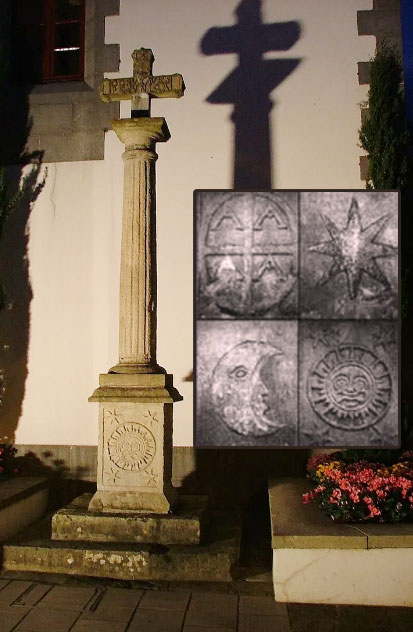
The history of Europe is etched into the stone of its great Gothic cathedrals, monuments dedicated to the Virgin Notre Dame that were remarkably all constructed within a narrow 100-year window. These structures were built using engineering knowledge that, by all standard accounts, was not supposed to exist during that era. When one takes the time to plot these cathedrals on a map, a fascinating pattern emerges: they mirror the celestial constellation of Virgo. This grand terrestrial map of the stars does more than just reflect the heavens; it points directly to a specific, unassuming monument in southwestern France known as the stone cross of Hendaye. This monument might seem simple to the casual observer, but it is described by the enigmatic writer Fulcanelli as being as strange as it is humble.
Within the construction of this cross lies an alchemical code, a silent message left for those initiated into the ancient mystery schools. One of the most striking features of the cross is the letter S, which serves as a symbol for the helioidal track of the sun as it reaches the zenith of its curve through space. This positioning is not merely astronomical but temporal, marking the arrival of a cyclic catastrophe. Fulcanelli was able to decode a Latin inscription on the cross that offers a cryptic promise of survival. The inscription reveals that there is a country where death cannot reach humanity during a period of “double cataclysm”. At this terrible time, a group described as the elite will participate in the return of a golden age, a transition where nature is renewed entirely by fire.
The physical structure of the cross of Hendaye provides further clues through its four-sided stone base. Each side carries a unique symbol that corresponds to the four ages of the Hindu yuga system. We currently find ourselves in the final age of this cycle, the Iron Age, or the Kali Yuga. According to the insights preserved in the stone, this current age of iron is defined by a single seal: the seal of death. The cross is essentially a pointer, identifying a specific moment in the long processional cycle of the Earth. This is the same moment identified by other ancient monuments, most notably those located on the Giza Plateau in Egypt.
If we were to travel back to the spring equinox in 10,500 BC, we would witness a perfect alignment between the heavens and the earth. During that time, the three stars of Orion’s belt formed the exact pattern that the three pyramids of Giza occupy on the ground. Simultaneously, the constellation of Leo would have risen in the sky, positioned so that the Sphinx was gazing directly toward it. This alignment occurred approximately 12,500 years ago, a date that coincides with records of the last great cataclysm found across various cultures. This 12,500-year-old moment is the same point in the cycle to which the cross of Hendaye directs our attention.
The Mayan creation myth, found in the Popul Vuh, describes multiple previous world ages that each concluded in a catastrophe. This narrative is echoed in the Hopi accounts of world history, which describe cycles where civilizations are wiped from existence as the gods abandon humanity at the end of each age. In recent years, much of the focus regarding these cycles centered on the year 2012, with many books claiming the Mayan calendar would end on December 21 of that year. However, those calculations appear to have been flawed because the Mayan long count calendar is measured in days rather than years.
The starting point of the Mayan calendar is August 11, 3114 BC, and it is designed to last for 1,872,000 days. The core unit of this system is the tun, which represents a 360-day year. This 360-day cycle reflects the actual length of a year at the time the calendar was created. It is not just the Mayans who remembered a 360-day year; research into ancient history shows that 30 different cultures documented a period of global upheaval that forced them to add five days to their calendars. This shift from a 360-day year to a 365-day year was recorded independently by civilizations all over the world at roughly the same historical period.
This celestial shift is even documented in the Bible. In the books of Isaiah and 2 Kings, there is a record of a miraculous event during the reign of King Hezekiah where the sun shifted its position. Scholars place Hezekiah’s reign between 701 and 713 BC, which aligns perfectly with the time-frame when cultures globally were adjusting their calendars by five days. Interestingly, while the book of Revelation was written around 95 AD – well into the era of the 365-day calendar – its prophetic calculations remained rooted in the older system of 360-day years and 30-day months. This suggests that the prophetic vision viewed the original 360-day framework as the correct way to measure time and cataclysmic cycles.
When we apply this historical adjustment to the Mayan calendar, the timeline shifts significantly. The calculation begins with the period from 3114 BC to 713 BC, which covers approximately 2,401 years of 360 days each. From 713 BC onward, we transition to the 365.25-day years that we use today, covering approximately 2,739 years. When these two periods are combined, the Mayan calendar does not end in 2012, but rather in the year 2046.
The year 2046 is significant for more than just the Mayan calendar; it marks a major astronomical alignment that mirrors the events of 12,500 years ago. In 2046, Orion’s belt will rise to its highest point in the sky. At the same time, the Sphinx will be gazing at the constellation of Aquarius. This is the exact opposite of the alignment in 10,500 BC, when the Sphinx faced Leo. This shift from Leo to Aquarius marks the completion of a massive half-cycle in the Earth’s history, pointing toward the very “double cataclysm” and renewal by fire that the cross of Hendaye was designed to warn us about.
 Part III: Cosmic Alignments and the Geometry of the Great Reset
If you look at the way ancient civilizations tracked time, you begin to see a recurring theme: the idea that human progress and decline are tied to the slow, majestic movements of the stars and planets. This isn’t just about daily horoscopes; it is about a massive chronological framework referred to as the Great Year [the Cycle of the Precession], a concept that has intrigued thinkers from ancient Greece to modern-day researchers.
The Clockwork of the Great Year
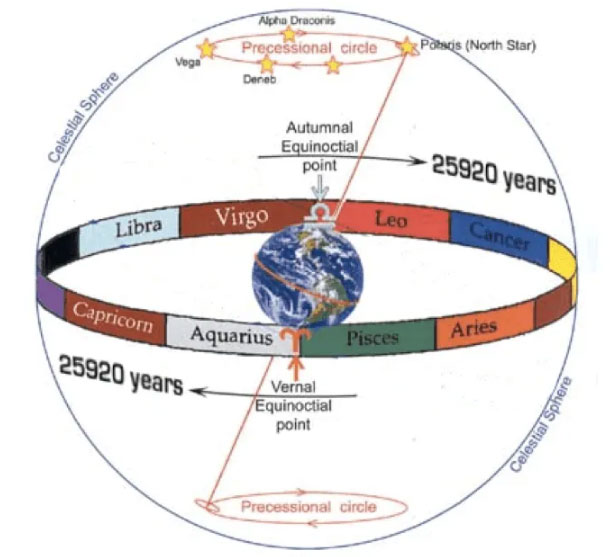
To understand where we are going, we have to look at the geometry of the sky. The ecliptic is the sun’s apparent path through the heavens, and it is divided into twelve equal sections of 30 degrees each. These sections are what we know as the zodiac, named after the constellations found within those specific sectors. In the 4th century BC, Plato elaborated on this by describing a “Great Year,” which he defined as the total cosmic time-frame required for every heavenly body to complete its individual cycle and return to an original, simultaneous alignment.
Later astronomers quantified this movement, realizing that the equinox shifts through one sign of the zodiac wheel every 2,160 years. When you multiply that by the twelve signs, you arrive at a complete Great Year of approximately 25,920 years. This is the master clock that seems to govern the “reset” of world ages.
Synchronicity Across Continents
What is truly fascinating is how different cultures, separated by oceans and millennia, arrived at nearly the same numbers. The Mayan Long Count calendar, for example, is composed of five world ages. Each of these ages is conventionally calculated at 5,125 years, meaning the full cycle of the Mayan calendar totals 25,625 years – remarkably close to the 25,920-year Great Year described in the West. The Mayan Long Count, historically marked in days, suggest that this grand cycle will conclude in the year 2046.
We see again a similar pattern in the Hindu tradition through the Yuga cycle. For a long time, it was believed that these cycles spanned millions of years, but in 1894, a discovery by Shri Yukteswar suggests ancient scribes had mistakenly substituted “divine years” for “human years”. When corrected, the complete Yuga cycle is revealed to be 24,000 years. Again, this aligns closely with both the Great Year and the Mayan ages.
The Breath of the Ages: Ascending and Descending Arcs
The Yuga cycle functions like a cosmic breath, divided into two 12,000-year arcs: one descending and one ascending. Each arc consists of four distinct ages, or Yugas, that represent different stages of human consciousness and societal health.
The sequence begins with the Satya Yuga, or the Golden Age, which lasts 4,800 years. This is followed by the Treta Yuga (3,600 years), the Dwapara Yuga (2,400 years), and finally, the Kali Yuga, often called the Iron Age, which lasts a mere 1,200 years. During the descending arc, humanity moves from the high peak of the Golden Age down into the density and decline of the Iron Age. Once the bottom is reached, the ascending arc begins, reversing the process and slowly leading mankind back toward another Golden Age.
Recent reconstructions of this framework suggest that the Kali Yuga – the darkest and most materialistic of the ages – actually ended in 2025. However, the transition out of such a dense age is rarely smooth. There are predictions that by the year 2040, the remnants of the Kali Yuga civilization could face a significant collapse, driven by a convergence of world wars, environmental catastrophes, and even comet impacts.
The Shadow of Saturn and the Black Sun
As we contemplate these cycles, a mysterious symbol often emerges in the background: the Black Sun. In ancient Mesopotamian astronomy, the planet Saturn was intimately associated with the sun, but it was believed to be black in color. This connection persists in our modern calendar; in ancient Rome, the first day of the week was dedicated to the sun (Dies Solis), while the final day was dedicated to Saturn (Dies Saturni).
Saturn is frequently represented by the symbol of a black cube, but both the cube and the planet itself are often seen as stand-ins for the elusive Black Sun. This isn’t a sun that provides visible light, but rather a source of “hidden” influence. In the tradition of alchemy, the Black Sun represents the nigredo stage – the first phase of transformation. It symbolizes the necessary destruction and decay that must happen before any true renewal or “Great Reset” can take place.
An Invisible Anchor in the Heavens
The concept of a hidden sun appears in several esoteric traditions. Helena Blavatsky referred to it as the “Central Sun,” an ultimate, invisible source of creative power that acts as a gravitational anchor around which all visible suns orbit. Shri Yukteswar identified this same central point as the driving force behind the Yuga cycle.
In astrological terms, the Black Sun refers to the empty focus of a planet’s elliptical orbit. Because planets do not move in perfect circles, there is always an “invisible” point opposite the sun within the orbital ellipse – a point of hidden planetary influence. This geometry suggests that what we cannot see is just as important as what we can.
The cube itself is a geometric encoding of this transition between dimensions. Every cube has an invisible geometric center that is equidistant from all six of its visible faces. Esoteric traditions identify this central, invisible point as the Black Sun. It is believed that a “Black Sun of Saturn” sits between the Earth and our sun, acting as an invisible mirror that modulates the sun’s long-cycle activity.
The Symbolism of the Reset
This invisible influence has been tracked by initiates for millennia. Its primary symbol, the black cube, can be found today in various significant places, from the architecture of Abrahamic religions to the corporate logos of some of the most powerful organizations on the planet. It appears that the symbol of the invisible Black Sun has been carefully preserved throughout the shifting cycles of time.
As we move deeper into this decade and approach the dates of 2040 and 2046, these ancient cycles and geometric symbols suggest that we are living through a pivotal transition. The “Great Reset” may not just be a modern political term, but a cosmic necessity – a return to an original alignment that has been pre-ordained by the very geometry of our solar system. We are moving through the final stages of a 25,000-year loop, watching the old world dissolve to make way for the next phase of the Great Year.
Source Material:
Part I: Proofs and Hypotheses for the Great Reset
Part II: Ancient Warnings to Survive the Great Reset
Part III: Cycles of the Great Reset and the Elusive Black Sun

Related posts:




Posted in Other Topics, True History of Manwith comments disabled.