
Philosophy, Reincarnation and The Long Road to Mastery
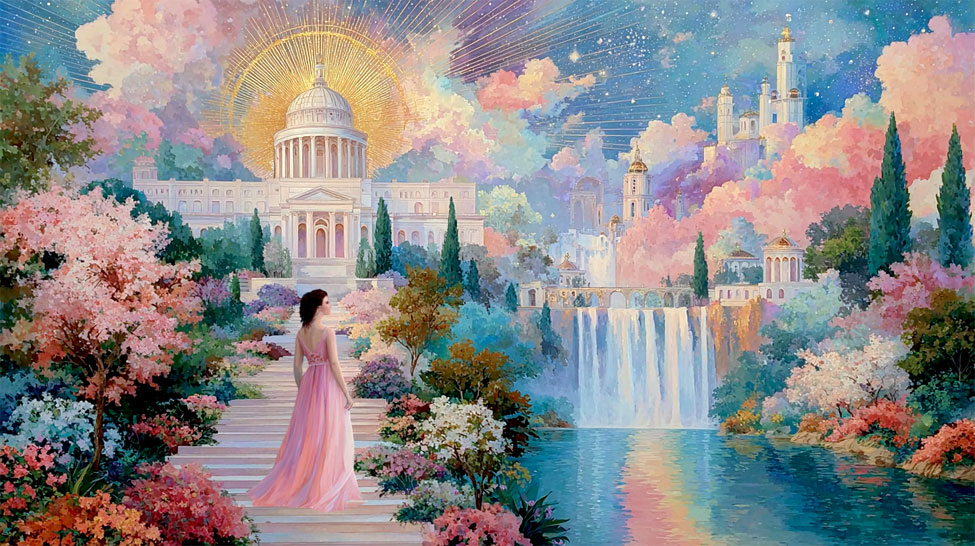 Synopsis of Chapter 50 from The Voice Of Eros
Have you ever had the feeling that there’s more to this life than what we can see and touch? That maybe, just maybe, we’re part of a much bigger journey – one that stretches across centuries, planets, and states of consciousness that our physical eyes aren’t quite tuned into yet?
If that idea resonates with you, then you’re in good company. Philosophers, mystics, and thinkers have been wrestling with it for thousands of years. But what if we could hear about it directly from someone who spent a lifetime thinking about these very questions – someone who now teaches on a plane of existence far removed from our own?
Today, we’re going to explore some fascinating concepts that were shared from a rather unexpected perspective: that of René Descartes, the 17th-century French philosopher, speaking from a spiritual center on a planet called Hermes. Now, before we go any further, let’s set the stage. This isn’t a history lesson in the traditional sense. Think of it more like sitting down with an old friend who happens to have a very unique vantage point on life, the universe, and everything in between. We’re going to cover what philosophy really means, how reincarnation works on a grand scale, and what it takes to progress from a beginner on Earth to a Master teacher in the spiritual realms.
 What Is Philosophy, Anyway?
When you hear the word “philosophy,” what comes to mind? For many of us, it conjures images of bearded men in togas, arguing in ancient Greek forums, or dense books filled with abstract ideas that seem far removed from daily life. But according to our guide from Hermes, that view is far too narrow.
Philosophy isn’t just a subject you study in school. It’s the very glue that holds our understanding together. It enters into everything around us. Even the natural world – the birds in the trees, the animals in the fields – has its own philosophical aspect. Think about that little bird building a nest outside your window. It has its own philosophy, you might say. It’s an incurable optimist, focused entirely on gathering worms and protecting its young. Its worldview is simple, but it’s a worldview nonetheless.
Philosophy, in this broader sense, is the adhesive substance of the mind. It’s what links the different parts of our nature – the physical, the mental, and the spiritual – into a coherent whole. It helps make life more conducive to growth and development. So, when we talk about philosophy here, we’re not just talking about abstract concepts. We’re talking about the very framework through which we experience reality.
 A Quick Spin Through Western Thought
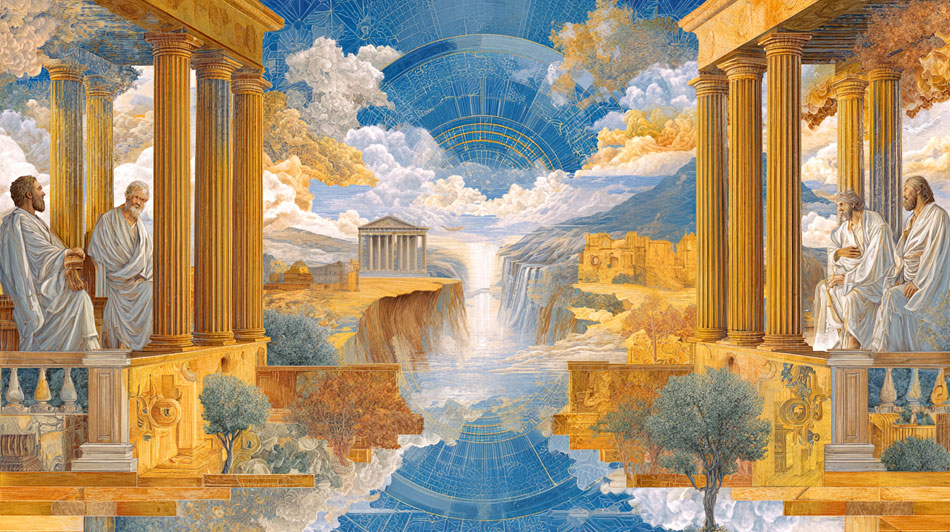
About 2,500 years ago, in ancient Greece, something remarkable happened. An age dawned that would shape the Western world’s approach to thinking for millennia to come. This was the Hellenic Age, a period that gave us some of the most famous philosophers in history.
We all know the names: Socrates, Plato, Aristotle, and others like Archimedes and Pythagoras. These weren’t just ivory-tower intellectuals. They were people trying to make sense of existence. Pythagoras gave us numerology, exploring the relationship between numbers and the universe. Hippocrates laid the groundwork for medicine, shifting the understanding of disease away from superstition and toward observation. And Plato? He introduced the Western world to one of its most enduring and controversial ideas: reincarnation.
Now, it’s important to note that these Western philosophies were distinct from the traditions emerging in the East. They were adapted to a different way of thinking. But at their core, the spiritual concepts were often closely interwoven. They all grappled with the same fundamental questions: Who are we? Why are we here? What happens after we die?
But the path of Western thought wasn’t always a smooth, open road. For centuries after the rise of the Christian church, philosophical inquiry became not just difficult, but dangerous. Following the resurrection of Jesus, two powerful institutions emerged – the Greek Orthodox Church and the Roman Catholic Church. For hundreds of years, the destiny of Europe became entangled with an ecclesiastical system that left little room for independent thought. It became unlawful, punishable by death, to live or speak outside of certain prescribed lines of belief. The church held the keys to heaven and hell, amassed great wealth, and even controlled kings and queens.
It was a time when questioning the accepted order could land you on a pyre, on a wheel, or at the end of a rope. Even a physician like Dr. Harvey, who proposed the revolutionary idea that blood circulates through the body, met a tragic end for his theories. It was a period of intellectual suppression that lasted for centuries.
The first major crack in this rigid structure came with Martin Luther. He was the one who finally broke free from the closed confines of that dogmatic order, sparking a reformation that would ripple across the world. After him, others followed – Bacon, Wesley, Wycliffe – each contributing to the liberation of thought and purpose. And in that lineage of free thinkers, our guide, René Descartes, played his own small part.
 The Long Road: Plato’s Take on Reincarnation
Now, let’s dive into one of the more intricate, interesting concepts that is shared: the structure of spiritual evolution through reincarnation. Plato’s ideas on this are used as a starting point, offering a framework for understanding how a soul grows over vast stretches of time.
The first thing to understand is that this isn’t a quick process. We’re not talking about living a few lives, learning a few lessons, and then calling it a day. The journey from a beginner to a Master is measured in tens of thousands of years.
According to this perspective, an individual starts at the very beginning of their evolution. Before they can even begin the serious work, they have to master three initial steps. These relate to three aspects of human nature: the carnal (physical), the mental, and the spiritual. You could think of them as the foundational building blocks.
Through many lifetimes on the physical plane, the individual works through these three concepts. They experience the physical world, they develop their intellect, and they begin to cultivate their spiritual awareness. Over time, they emerge from the carnal and mental states into a more focused spiritual consciousness. This crystallizes their ambitions and points them toward a purpose beyond themselves. It’s at this point that they become ready to take what is called the “first spiritual initiation”.
But here’s where the scale of this journey really comes into focus. To reach that first initiation, the individual must pass through “seven basic fundamental cycles” of evolution. Each cycle involves reincarnating not just on Earth, but also into higher astral worlds – places like the spiritual centers of Shamballa such as Muse, Hermes, Venus, and other relative planes.
Why many different places? Because learning isn’t one-dimensional. Let’s use an example that was given: a musician. To become a true master of music, it’s not enough to simply learn how to play an instrument. The musician must also understand harmony, rhythm, composition, and the emotional and philosophical underpinnings of sound. So, on the planet of Muse, for instance, they would pass through centers related to their core concept of music. They would undergo initiations that allow them to travel and learn across five different centers, deepening their understanding at every step.
By the time they complete these seven cycles, they have formed a fundamental, bone-deep concept of their profession – whether it’s music, philosophy, or science. They have become a “spiritual initiate”. In our own history, we’ve seen these initiates expressed as the great composers: Beethoven, Bach, Wagner, Mendelssohn. They weren’t just talented; they were souls who had undergone millennia of training to bring that level of expression into the physical world.
 The Numbers: How Long Does It Take?
This is where we start to get into some very fascinating details. The process is not random; it follows a kind of cosmic arithmetic. According to what is shared, the seven basic cycles that lead to the first spiritual initiation take the average person about ten thousand years to complete, using Earth years as a measure.
Once that spiritual initiation is achieved, the soul ascends to a higher center. There, they start a “new” series of seven cycles, working through the seven centers of the center of Parhelion. Each of these cycles can take anywhere from one thousand to three thousand years. So, completing these seven cycles – and thus becoming a “Master” – takes somewhere in the ballpark of fifteen to twenty thousand years of normal spiritual progression.
But here’s the catch: those are just averages. Some souls take much longer, perhaps three or four times that amount. It depends entirely on the individual. How much karma did they pick up along the way? What specific lessons did they choose to focus on? Did they decide to reincarnate into Earth plane dimensions multiple times to strengthen and solidify the concepts they’d already learned?
The path is not a rigid conveyor belt. An individual might spend a hundred thousand years or more before they reach the point where they can be considered a Master and a teacher in one of the great spiritual centers. Some souls may even choose to work in other galaxies or other universes entirely. The point is, this is a journey of immense patience and dedication, not a race to the finish line.
The intervals between incarnations also follow a pattern. Reincarnations tend to occur in regular intervals – often in multiples of three hundred years: three hundred, six hundred, nine hundred, and so on. There’s a relationship to numbers here, echoing the teachings of Pythagoras, who explored the fundamental nature of numbers. The number twenty-one is particularly significant, representing something like twenty-one thousand years before you become an initiate in the centers of Shamballa.
 What It Means to Take the First Step
So, after all those thousands of years of living, learning, and evolving, what does it actually “look like” to reach that pivotal moment? What is the first spiritual initiation?
It’s described as a fundamental shift in consciousness. After spending a great many lifetimes in the physical planes – some of which might be in states of consciousness even denser and slower than our own Earth – the soul evolves to a point where it dedicates itself to a spiritual purpose.
This isn’t a decision made lightly. It’s not like waking up one day and deciding to be a nicer person. It’s described as being “fired and consumed” with an idea. The soul becomes passionate about learning, about expressing, and about teaching for the benefit of others. It’s a complete reorientation of one’s being, moving from self-centered evolution to a path of service. It is only at this point that the soul begins its gradual climb into the spiritual realms of consciousness – the dimensions we’ve been exploring.
 Welcome to Hermes and the City of Aureleus
Now that we’ve laid the groundwork for this grand journey of evolution, let’s talk about one of the destinations along the way: the planet Hermes and its central city, Aureleus. If you’ve heard about other spiritual centers of Shamballa, such as the planet Muse, Aureleus will feel familiar. But it has its own distinct character.
As you approach Hermes, the first thing you notice is that the planet itself seems to be alive. It throbs and pulsates, oscillating with a variety of colors. But the predominant color here is green. Not just any green, but a soft, soothing green. In the language of energy and vibration, green is related to the aspect of understanding. It’s the color of balance, growth, and wisdom. It sets the tone for what you’ll find on the surface.
Descending into the city proper, you are immediately struck by its scale. There is nothing on Earth that compares. The cities in these spiritual planes are vast, stretching out in all directions. Aureleus is divided into a large number of sections, each one dedicated to a different culture or aspect of philosophical study.
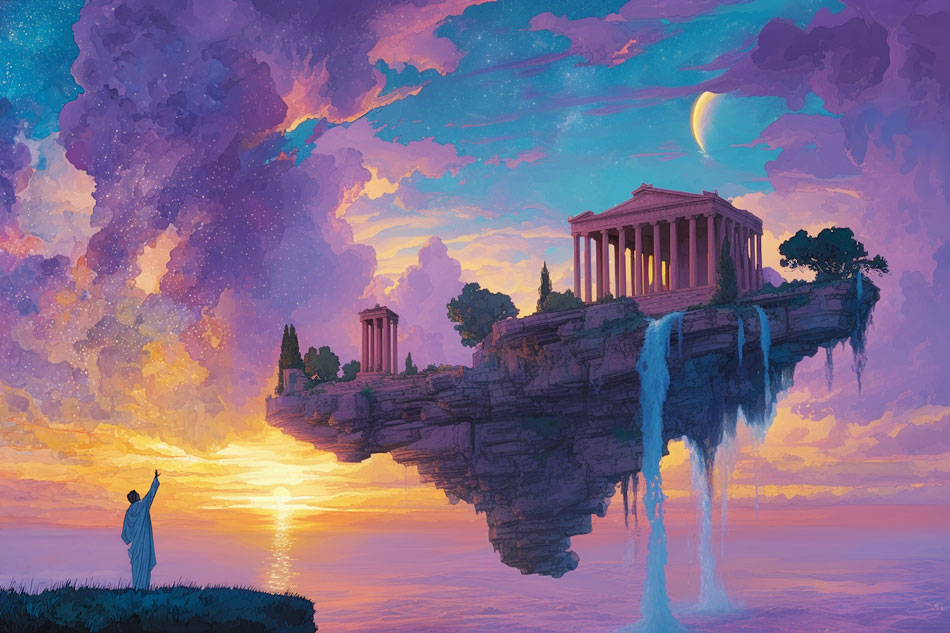
For instance, there is a massive cultural center designed in the style of Hellenic or Athenian art and culture. This section is devoted to the philosophical sciences, honoring the lineage of Greek thought that shaped so much of Western civilization. It’s a place where the initiates and teachers who once walked the forums of Athens now continue their work.
But that’s just one section. There’s also a Chinese section, where the architecture and the atmosphere are distinctly Mongolian in aspect. Here, you’ll find students and teachers who were once incarnated in China and Japan. And beyond those familiar sections, there are others where the architecture and outlines of the buildings are completely strange and unfamiliar. These sections relate to other earth-plane dimensions – other streams of human evolution that we haven’t explored and aren’t familiar with.
It’s entirely possible that some souls reading this have incarnated into some of those spiritual planes in past lives. But in our current state of consciousness, we don’t retain any fundamental memory of those experiences. They remain hidden, waiting perhaps for a future stage of our journey.
 The Challenge of Translation
One of the more interesting aspects of this whole account is the acknowledgment of the limits of language. Our guide notes that in these spiritual centers, a universal language is used – one that doesn’t rely on vowels and consonants in the way we’re used to. It’s a language of pure concept, of direct transmission.
This presents a real challenge when trying to share these experiences back on Earth. How do you take the fluid, multi-dimensional nature of a spiritual concept and squeeze it into the linear, sequential structure of a sentence? The very act of translation is imperfect. Words like “philosophy,” “reincarnation,” and “initiation” are just approximations. They’re the best tools we have, but they can only point toward the reality they’re trying to describe.
It’s a humbling thought. We’re so used to treating language as the ultimate tool for conveying information. But in the grand scheme of things, it’s more like a rough sketch – useful, but incapable of capturing the full color and depth of the original.
 Wrapping Up: A Journey Without End
So, where does all this leave us? We’ve covered a lot of ground – from the true meaning of philosophy, to the long and winding road of spiritual evolution, to a glimpse of a city on a distant planet that exists in a different dimension of consciousness.
It’s a lot to take in. But maybe the key point isn’t the specific numbers or the names of the planets. Maybe the key point is the “scale” of it all. The idea that our current life, as important as it feels, is just one small chapter in a story that stretches across millennia. The challenges we face, the lessons we learn, the passions we develop – they’re all part of a larger curriculum.
The journey from a beginner to a Master isn’t measured in decades, but in tens of thousands of years. It involves exploring not just Earth, but other spiritual planes and other cultures across the cosmos. It requires mastering not just one skill, but the entire interwoven web of concepts that give that skill its meaning.
It’s a journey that demands patience, dedication, and an unwavering commitment to growth. And the first step on that journey isn’t about achieving some spectacular spiritual feat. It’s about reaching a point where you become fired and consumed with a desire to learn, to express, and to serve. It’s about reorienting your life around a purpose that extends beyond your own immediate needs.
Whether you view this as a literal road map of the soul’s journey or a powerful metaphor for personal growth, there’s a certain beauty in the scale of it. It invites us to think bigger, to be more patient with ourselves and others, and to recognize that every experience – joyful or painful – has a place in a much larger story. And while the road is long, we can approach life with a philosopher’s curiosity, seeing the adhesive substance of mind in everything around us.
Until we have the chance to explore further, may we all find a bit more understanding, a bit more patience, and a bit more of that radiant wisdom in our innermost being.
See full pdf book download The Voice Of Eros by Ernest L. Norman here.

Related posts:


Posted in Book Excerpts, Spirituality, Voice of Eroswith comments disabled.