
Hidden History: The Templar Legacy
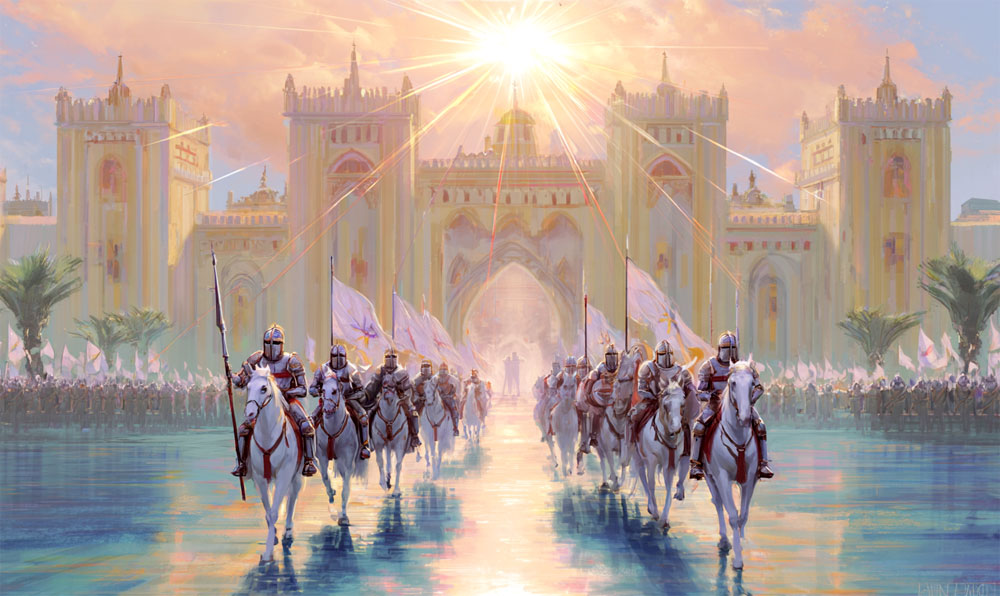 Synopsis of lecture by Timothy Hogan, 33rd Grand Master Knights Templar
There are certain corners of history that feel less like the past and more like a puzzle box left behind by a previous civilization. The story of the Knights Templar is one of those corners. Most people know the broad strokes: a medieval military order founded to protect pilgrims in the Holy Land, which grew into a formidable economic and political power, only to be arrested, tortured, and burned at the stake by a desperate French king on Friday, October 13, 1307. It is a story of rise, riches, and a sudden, brutal fall.
But that standard narrative, as satisfying as it is, has always had a peculiar loose end. What happened to the Templar fleet? On the night of the arrests, their ships – scores of them, by some accounts – simply vanished from the port of La Rochelle. No records of their destination survive. And it is that single, silent departure that serves as the doorway into a much deeper, stranger, and more compelling lineage. One particular exploration of this lineage, offers a guided tour through the aftermath, arguing that the Templars did not so much end in 1307 as they went underground, regrouped, and continued to shape the world from the shadows for the next seven hundred years.
This is not a tale of simple historical revisionism. It is a connective tapestry that links Scottish battlefields, pirate flags, the Great Seal of the United States, unidentified aerial phenomena, and the properties of monatomic gold. Whether one accepts every link or simply finds the connections curious, the journey itself is a remarkable exercise in seeing the long arc of a secret tradition.
The Night the Fleet Vanished: Three Destinies
The narrative begins in earnest on the night of October 12, 1307. King Philip IV of France, deeply in debt to the Templar Order, moved to destroy them. His agents prepared sealed orders to be opened simultaneously across the kingdom the next morning. But someone warned the Templars. That same night, the Order’s treasure-laden fleet departed La Rochelle, leaving behind only questions.
According to historical tradition, the fleet did not sail to a single refuge but scattered into at least three distinct currents of history.
The first and most politically significant destination was Scotland. At the time, Scotland was under interdict (official papal censure or ban) from the Pope and fighting for its survival against England’s Edward II. This provided a unique sanctuary: a Catholic king, Robert the Bruce, who was already excommunicated and therefore had little to fear from shielding heretics. The legend holds that a contingent of Templar knights fought alongside Bruce’s forces at the Battle of Bannockburn in 1314. The battle was a stunning Scottish victory against a larger, better-equipped English army, and it secured Scotland’s independence. Within the Templar tradition, this is no mere coincidence. The knights are said to have provided not only martial skill but a secret weapon or tactical knowledge that turned the tide. This is the origin of the claim that the Templars lived on, buried in Scottish clans – most notably the Sinclairs of Rosslyn Chapel fame – and that their rituals and symbols seeped into Scottish Freemasonry centuries later.
The second destination was Portugal. Here, the Templars found a more straightforward path to survival. King Denis of Portugal was grateful for the Templars’ role in fighting the Moors, and he refused to persecute them. Instead, he simply rebranded them. In 1319, the Order of Christ was established, absorbing Templar assets, members, and traditions. Under this new banner, the Templars continued their work, most famously becoming the financial and nautical brains behind Portugal’s age of exploration. Prince Henry the Navigator was a Grand Master of the Order of Christ. His famous caravels, the ships that launched the transatlantic slave trade and eventually reached the Americas, flew the red cross pattée of the order. When Columbus later sailed for Spain, his own ships carried a similar Templar cross on their sails, a connection that is either convergent design or evidence of a wider network.
The third destination is the most romantic and the most shadowy: the open ocean, specifically the Barbary Coast of North Africa. Those Templar ships that did not go to Scotland or Portugal, it is said, turned to piracy. Former knights, trained in naval warfare and logistics, became the first of the Barbary pirates. And here, a remarkable piece of symbolic archaeology is presented: the Jolly Roger, the skull and crossbones. To a modern observer, it is a simple threat of death. But within the Templar tradition, the skull represents Golgotha, the place of the skull where Christ was crucified, and the crossbones represent the crossed keys of St. Peter or the crossed swords of martyrdom. For the Templars, the symbol was not one of terror but of resurrection. A pirate flying the skull and crossbones was not just a criminal; he was a member of a dispossessed order declaring that they had died to the world and been reborn outside its laws. This reframing turns the golden age of piracy into a kind of Templar diaspora, with men like Blackbeard and Captain Kidd functioning less as rogue outlaws and more as independent operators of a broken but unbroken tradition.
The American Thread: From Sea Dogs to the Great Seal
The narrative then leaps centuries, tracing a line from the pirate havens of the Caribbean to the founding of the United States. This is where the Templar legacy becomes interwoven with the familiar iconography of American power.
The first connecting figure is John Paul Jones, often called the father of the American Navy. Before the American Revolution, Jones sailed out of the same Scottish ports and maritime circles that had harbored Templar descendants. His daring, his unconventional tactics, and his personal symbolism are all presented as part of a continuous tradition. He was, in this reading, a naval knight-errant for the new republic.
But the most astonishing connection involves the Great Seal of the United States and the dollar bill. Every American has seen the all-seeing eye atop the unfinished pyramid. Standard history attributes this design to Charles Thomson and William Barton, who drew on Renaissance iconography. The story here is both more specific and more esoteric.
The individual credited with proposing this exact design to President Franklin Delano Roosevelt is Nicholas Roerich, a Russian painter, philosopher, and archaeologist. Roerich was not merely an artist. According to the tradition, he was an initiate within the Templar-derived lineage, a custodian of secrets. In the 1930s, Roerich was a close advisor to FDR on cultural matters and, more secretly, on the symbolism of the coming American century. It was Roerich who reportedly suggested that the Great Seal should explicitly evoke not just a national symbol but a memory of the antediluvian civilization that the Templars believed they were rebuilding.
What does that mean? The unfinished pyramid represents a body of knowledge that is incomplete, waiting for the final capstone. The all-seeing eye is not just God but the “Eye of Providence” as understood within esoteric traditions – a symbol of a cosmic order that predates the Bible. The Latin phrases reinforce this: Annuit Coeptis (He [Providence] has favored our undertakings) and Novus Ordo Seclorum (A New Order of the Ages). The latter is key. It is not just a new order of centuries but a New Order of the Seclorum – a phrase deliberately chosen to echo the ancient ages or yugas of pre-history. Placing this on the dollar bill, the most ubiquitous piece of American daily life, means that every citizen unknowingly carries a Templar-promoted symbol of a lost golden age in their pocket.
From John Paul Jones to Franklin Delano Roosevelt, the narrative sees an unbroken thread of figures aware of this legacy, guiding the American experiment as a deliberate continuation of the Templar project: the re-establishment of a global order based on a secret, universal, pre-Christian wisdom.
The UAP Dimension: Observing the Sky for Centuries
The most unexpected turn in the journey is the one that moves from terrestrial history to the skies above. The exploration of the Templar tradition here includes a sustained examination of what are now called Unidentified Anomalous Phenomena (UAP). The claim is not that the Templars encountered aliens in any modern sense, but that the order maintained a continuous, institutional interest in unexplained aerial objects, treating them as a natural, if rare, part of the cosmos.
This history is traced through specific records.
Roger Bacon (13th century): The Franciscan friar and philosopher, often considered a precursor to modern science, wrote detailed descriptions of flying machines. He was also reputedly connected to the early currents of what would become the Rosicrucian and Templar underground. His writings do not describe alien ships but rather speculate on mechanical flight. However, within the tradition, Bacon was reporting on knowledge preserved from older sources.
Francis Bacon (17th century): In his utopian work New Atlantis, Bacon describes the “College of Solomon” (or Solomon’s House), a secretive institution of scholars who possess advanced knowledge. Crucially, the book includes a scene where a flying machine – a “UFO” in all but name – descends to deliver a blueprint for advanced technology to the college. For Francis Bacon, a key figure in the development of the scientific method, this was not fantasy but a philosophical statement about the source of higher knowledge.
The Rosicrucian Painting (1598): A specific painting from the late 16th century, produced by the Rosicrucian order (which shares deep roots with Templar traditions), depicts angels as central figures in flying discs. This is not an abstract halo or a winged figure; it is a literal metallic disc. It suggests that the artists were either recording an observed phenomenon or symbolically encoding a technological memory as angelic.
Nicholas Roerich (1920s Central Asia): Returning to the figure of Roerich, his diaries recount an incident while traveling through the Altai Mountains. He and his party witnessed a large, shining disc cross the sky, bank, and disappear. The local guides were not surprised. They identified it as the “flying ship of King Solomon,” a legend found in both Ethiopian and Asian traditions describing a device that allowed the wise king to survey his vast domains. For Roerich, this was not a modern UFO sighting but an ancient phenomenon, documented for millennia, making a routine appearance.
The earliest textual evidence cited is the Tulli Papyrus, an Egyptian document (some debate its authenticity, but it is accepted within this tradition) describing fire circles appearing in the sky during the reign of Thutmose III. The circles were described as “flying discs” made of fine material. The Egyptian scribes carefully recorded their movements as they would any natural phenomenon.
The conclusion drawn from this timeline is that UAPs are not a post-1947 phenomenon. They are a persistent feature of the human environment, and the Templar lineage – through the Bacons, Roerich, and their sources – has maintained a secret archive of observations and theories about them for seven centuries, treating them not as visitors from another planet in the space-travel sense, but as manifestations of a density or dimension that intersects with our own at specific times and places.
Monatomic Gold, Manna, and Cosmic Origins
The final layer of the narrative ties all these threads – the political escape, the American symbolism, the UAP observations – to a single, physical substance: monatomic gold, also known as white powder gold or ORMUS.
This is not the gold of coins and jewelry. Monatomic gold is a non-metallic, superconductive powder produced by a specific chemical process that separates gold atoms into a high-spin state where they do not bond with each other. The claim within the tradition is that this substance has remarkable properties. When ingested, it is said to heighten awareness, extend life, and even allow the body to withstand higher energy states.
The connection to biblical history is direct: the manna that fed the Israelites in the desert. The word mana itself is Egyptian for “what is it?” The description of manna – a white, flaky substance that appeared with the dew, had to be gathered in specific amounts, and could not be stored without spoiling – matches, in this interpretation, the properties of unstable monatomic gold. Furthermore, the Ark of the Covenant contained a golden pot of manna. The Ark was not just a religious symbol; it was a device, a capacitor that held the manna in a stable state. The UAP connection emerges from the Vedic texts of India, which describe vimanas, flying ships piloted by heroes, which were powered by a similar white powder. Solomon’s flying ship, the discs seen by Roerich, and the vimanas all run on the same fuel source.
The grand, final proposal is one of cosmic archaeology. Across the planet, ancient sites are aligned to specific stars – Orion, the Pleiades, Sirius. The Great Pyramid’s shafts point to Orion’s Belt. The temples of Angkor Wat mirror the constellation of Draco. The Nazca lines include giant figures that some interpret as astronauts.
According to the Templar tradition, this is not coincidence or primitive astronomy. It is a message. A pre-civilization – the antediluvian world of myth, the “Age of the Gods” found in every culture – encoded a map in stone. The message is simple: YOU came from the stars. The Pleiades and Orion are not just constellations; they are ancestral origins. The Templar tradition, passed from the Egyptian mystery schools through Solomon, into the medieval order, and out through Scotland, Portugal, and the pirates, has been the faithful, if often hidden, custodian of that message. Their survival after 1307, their seeding of American symbols, their quiet study of the skies – all of it has been in service to a single goal: waiting for the moment when humanity is ready to decode its own forgotten cosmic ancestry, a moment which, the argument suggests, may be now.
This is a dense and interlocking worldview. It asks a lot of the listener: a tolerance for sweeping connections, a willingness to see the Jolly Roger as a sacred symbol, the dollar bill as an esoteric document, and a UFO as a flying ship of Solomon. You do not have to believe any of it to find value in the exercise. What this legacy of hidden history truly offers is a mirror. It reflects a deep human hunger for patterns, for secret lineages, for the assurance that the chaos of history is not random but is the working-out of a plan, however concealed. Perhaps the real legacy of the Templars is not any single secret they carried, but the enduring conviction that beneath the surface of ordinary history, a deeper current flows – and that with enough patience, anyone might learn to decipher its message.

Related posts:


Posted in Other Topics, True History of Manwith comments disabled.