
A Three-Day Journey With Visitors From Aldebaran
 A summary of the first fifteen chapters of “UFO Contact
From Planet Arian of Aldebaran” by Martin Wiesengrun
There is a category of UFO contact story that defies easy dismissal — not because it is sensational, but because it is relentlessly specific. UFO Contact From Planet Arian of Aldebaran belongs to that rare category. Written under a pseudonym by a man who calls himself Martin Wiesengrun, the book recounts experiences he had as a fifteen-year-old boy living on the island of Rügen on East Germany’s Baltic coast in 1957 — a time when the Soviet-controlled DDR was completely sealed from the West, and when the word “UFO” would have meant nothing to an ordinary teenager in Baldereck.
What follows is a chapter-by-chapter summary of the first fifteen chapters, covering the initial contact, the boarding of an extraterrestrial craft, and three days of extraordinary education delivered by a panel of scientists from multiple star systems.
Chapter 1 — Before the First Contact: Strange Shadows Over Rügen
Martin is the kind of boy who spends his afternoons at a secret coastal hideaway he has carved into the chalk cliffs northeast of his village — a panoramic perch above the Baltic where he watches Swedish ships tack across the water and Swedish fishing boats follow the wind. It is an idyllic, isolated life. And then, in the summer of 1957, everything changes.
In June and July, a peculiar shadow — oval-shaped, fringed at its edges, about five meters across — begins gliding silently over him whenever he walks toward his hiding place. He notices that after each encounter, he feels an inexplicable wave of peace and mild euphoria. Then on July 18th, lying in the meadow near the cliff with his sunglasses on, he sees them clearly for the first time: two gigantic rings hovering 150 to 200 meters overhead, one round and one triangular, pulsating with shifting colors — light yellow, dark yellow, red, dark red. The triangular craft dives toward him. He runs. He collapses. He wakes up five minutes later in the grass with his heart pounding and a sensation that someone has been “searching in his brain.”
That night he has a vivid dream. Two beings with antennae-like features on their heads emerge from fog beside two strange trees. They invite him to come with them. He agrees, asking only that they meet on July 23rd — five days away — at 4:00 in the morning. The beings accept his terms.
Chapter 2 — First Contact: Two Tall Visitors in the Dark
At 3:40 AM on July 23rd, Martin walks to the old farmstead near his hiding place, his nerves tightening with each step. He sees a reddish blinking light in the bushes. Then the bushes part.
Two beings step out, exactly as in the dream: helmeted, dressed in silver fitted spacesuits with chrome visors and colored glass panels, with thick arm-length hoses running from wrist to shoulder. Standing beside them, Martin feels like a child. The smaller of the two is approximately 2.2 meters tall (about 7’2″). The larger is 2.3 meters (nearly 7’7″).
The smaller being — a woman — removes her helmet. Copper-brown skin is revealed; long brown hair falls to her shoulders. She has reddish eyes, four fingers on each hand (not five), and a backpack-sized container on her back connected by hose to her suit. Martin will come to think of her simply as his “fairy.” The larger figure is male, with a roundish face, heavily prominent eyebrows over dark slanted eyes, and an exceptionally large nose. Both wear a rectangular yellow symbol with the shape of a reversed “Z” at the chest.
The craft behind them is 50 to 60 meters in diameter — Martin estimates this carefully against the line of utility poles behind it, each 5 meters apart. It is triangular in construction with heavy rounded wingtips extending far behind. Multi-colored position lights blink on its hull. Two glowing white half-spheres hang beneath it. A black ladder extends to the ground from an entry port. The whole machine stands about 8 to 10 meters from bottom to top of its cabin.
Chapter 3 — Boarding the Small Ship
The female being motions him to enter. Martin hesitates, then sprints for the ladder and climbs aboard. A small brown hand at the top helps push him up the last few rungs.
Inside, he finds a room of about 45 to 50 square meters, bathed in soft warm light like a summer evening. A curved control panel spans a full half-circle, fronted by six rotating seats upholstered in a velvety material unlike anything made on Earth — no seams, no sharp edges. To the right, a large monitor glows soft blue, surrounded by instrument gauges, blinking lights, and small switches. Warning signs on inner doors show triangles and angles glowing in sequence: white, green, blue, yellow.
The crew numbers five: three women and two men. The commandant is a slender female with high cheekbones, dark shiny eyes, and reddish-brown hair — someone who radiates, in Martin’s words, “an impression of adventure.” The beings speak to each other in a high-pitched, fast, singing-like voice. When Martin tries to explore a restricted door, the woman who helped him aboard blocks his path with a knowing look. He nods and steps back.
Chapters 4–6 — To the Mother Ship: A Galactic Research Center
In the chapters that follow, the small shuttle craft docks with a vastly larger vessel — the mother ship — and Martin is transported inside what is described as a Galactic Research Center led by a scientist named Dagolo, a tall woman from the planet Arian. Arian is the fourth planet from its sun, 59 light years from Earth (which the visitors call “Arula’s system”).
Dagolo’s workspace is a five-cornered room of approximately 50 to 60 square meters, with walls of a glass-like material etched with intricate engravings of mythological and composite animals — winged water lions, unicorns, centaurs, dinosaurs. A small ornate fountain trickles in the corner. Recessed drawers are hidden seamlessly in the walls. Through an inner door is a hotel-quality bedroom prepared for Martin, complete with a pajama laid out and a shower that releases warm, pine-scented mist.
Dagolo hands Martin a headset — a universal translation device connected to the ship’s “Language Knowledge Container,” which holds all past and present languages of Earth and dozens of other worlds. The scientific panel assembles.
Chapter 7 — Humanity at the Time of Your Dinosaurs
The gray-skinned scientist named Ti, who comes from the planet Uru (sharing the same sun as Arian), introduces the panel: Dagolo from Arian; Ti from Uru; a being from the planet Gne (850 light years from Arian, with four-fingered hands); and a hairy, androgynous being from the planet Pall — the Pallian, whose people live to 360 years, maintain a stable population, and only when they discover that they love one another deeply and do not separate, one transforms biologically into a female who then can give birth.
The computer then presents 70 million years of Earth history. The screen shows the solar system as the visitors understand it: Earth, Mars, and a now-destroyed planet called Satanis. Satanis exploded and was pushed out of its orbit, eventually becoming the asteroid belt.
Seventy million years ago, two primitive hominid races existed on Earth: forest dwellers (light-brown skinned, fruit and grass eaters) and marsh dwellers (dark-skinned, webbed fingers and toes, expert water hunters). The two races traded — meat and tools for fish and shells — but interbreeding produced no offspring.
Then came the visitors. Multiple space-faring hominid civilizations were mining Earth for a rare iron alloy — mixed with aluminum, manganese, copper, silver, gold, tin, and nickel — needed to resurface the outer hulls of their mother ships. They needed workers for the mines. The native Earth races were too physically weak. The solution: genetic engineering. By crossing the genes of visiting races (particularly the Pallian people) with the marsh dwellers, they produced a hybrid population strong enough for heavy labor. When the mining became unprofitable, the space visitors left — and abandoned their hybrid creations to fend for themselves. Over the next several million years, the original forest and marsh races died out, leaving only the engineered hybrids: the ancestors of modern humanity.
Chapter 8 — A Meteorite Hits Earth
After a shared meal in the ship’s elaborate dining room with different types of seafood, fresh salads, flower blossoms, and sweet water — the computer resumes its presentation.
Approximately 65 million years ago, three massive planetoids were on a collision course with Earth. Two Pallian research ships in Earth’s orbit detected the threat and launched an emergency response. They reduced the smallest planetoid to dust and deflected the middle one off course. The third and largest — weighing nearly 100,000 tons — proved too large to deflect entirely. It struck the Earth’s crust at catastrophic speed, sending millions of tons of rock and soil into the atmosphere, triggering earthquakes, 60-to-70-meter tidal waves, months of electrical storms, and cascading volcanic eruptions. It was, Martin reflects quietly, almost certainly the event that killed the dinosaurs. Earth’s small hominid population survived.
Chapters 9–10 — A Night Aboard the Ship, and a Body Full of Electrodes
That evening, after the scientists fall into one of their lively and incomprehensible debates, Martin’s exhaustion wins out. Dagolo shows him to his bed, where he falls into a dream of cascading waterfalls and meadows of flowers.
In the morning, Dagolo delivers startling news: while Martin slept, technicians inserted hair-thin electrodes into his body — into his fingers, beneath his fingernails, in his feet, his ears, his cheeks, his neck, and finally into his brain. The electrodes connected him to a computer that scanned his biological and spiritual data in full. The dream they gave him had been intentional — a technique to relax the body and allow painless insertion. All the electrodes have been removed. He feels nothing.
Dagolo explains: “The body dies, but the soul of each individual is immortal.” The scan has collected not only his physical health data but spiritual information — data that, she promises, will open new abilities and possibilities in his future life, though the full effect will only become apparent years later.
Chapter 11 — Watching His Own Soul Leave His Body
A new scientist arrives: a Satanian, from the destroyed planet Satanis’s surviving diaspora — blond and wavy-haired, with light gray eyes, a Roman nose, and five long fingers. He takes charge of the next presentation.
The screen replays footage of three small yellow-suited robot beings — each about 1.5 meters tall, with enormous heads and dark glassy lens-eyes — performing the electrode procedure on Martin’s sleeping body. The robots move with eerie precision, then exit satisfied.
Then the Satanian shows Martin something almost impossible: a recording of his own soul separating from his sleeping body. The luminous figure rises from the sleeping form, moves freely through the room for a few seconds — Martin’s own face clearly visible on the floating shape — and then settles back in. The sleeping body turns on its side. The soul is back.
The scientific panel then demonstrates comparative brain scans: Martin’s brain capacity is shown alongside those of the various hominid races present. His is noticeably lower — not as an insult, but as a statement of fact about where Earth humanity currently stands in its development. The Pallians, for instance, have expanded their brain storage over centuries by changing their learning methods and adjusting to increasing flows of information. Earth, the panel implies, is still early in this process.
Chapter 12 — Insight into the Human Body: Meeting Krotk
Martin meets Krotk — a 17-year-old in Earth years (130 years by ship time) who was born and raised aboard the Mother Ship. Krotk has reddish hair to his shoulders, a quick laugh, and an easy, brotherly manner with Martin. He becomes Martin’s personal guide for the remaining time aboard.
Krotk introduces a remarkable demonstration: the Satanian scientist is missing his right arm and right leg from a plantation accident aboard the Mother Ship. In their place are perfect microelectronic prosthetics — indistinguishable in color and appearance from natural limbs, and fully integrated with the living nervous system. Krotk walks Martin through the drawings showing exactly how the synthetic limbs connect to the living nerve cells, how the signals flow, and how the body responds as if the limbs had never been lost.
Chapter 13 — Time Tears, Sound Weapons, and Alien Technology
In the physical-chemical laboratory, Krotk demonstrates a series of technologies that stretch Martin’s comprehension to its limit. A laser-like beam cuts through his small stone from Rügen as cleanly as a polished mirror. Then one half of the stone is dissolved by another beam; the other half is liquefied in solution, poured into a mold, reconstituted — and rematerializes, whole, on a distant tray.
Sound waves are next. Krotk snaps his fingers and explains that even this simple act emits waves that, when amplified a thousand times, can push a hillside like wind. A demonstration shows the amplified wave moving mass with ease. Properly controlled, such waves can also heat or cool.
The most disorienting revelation: “secondary time splits.” Krotk shows Martin how, using short sound waves of immense energy, air becomes visible — appearing as fractured, boiling glass — and within the fractures, rips appear. These rips, when expanded, create time holes: passages to the past, the future, or entirely different dimensions and universes. Transgress the fundamental laws of nature in the process, and you are “absolutely and completely lost.” As a final proof, a metal square is brought in: it looks and feels like dense metal, yet weighs almost nothing. When Martin turns it in his hands, it crumbles silently to powder.
Chapter 14 — The Mother Ship: A City Among the Stars
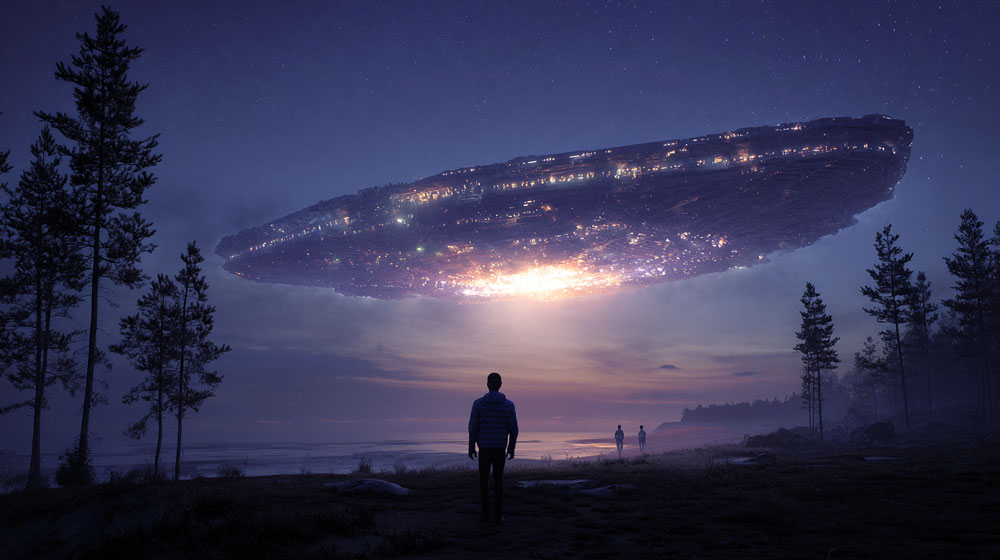
Krotk saves the most staggering revelation for the end of this session. The viewing screen pulls back from Earth, past the solar system, and into deep space — until a glowing structure fills the screen. It is the Mother Ship: a city built around eleven massive connected rings, each ring enclosing its own complete world and ecosystem. The rings are linked by long tubes running inward to a central sphere of brilliant light — the power unit.
The Mother Ship is 600 kilometers long and 510 kilometers wide at the rings. Its vacuum fusion power unit alone measures seven by eight by eleven kilometers. At maximum speed, it travels 1,940 times the speed of light — fast enough to enter other dimensions and universes. It houses 1.5 million beings from eleven different hominid races, each living section designed to approximate the natural environment of its species’ home planet.
Inside, cultivated fields of grain, fruit trees, and vegetable gardens grow under artificial light. Flower plots are placed deliberately between grain fields to control pests biologically. Small farmed lakes provide fish. A hybrid bird — the product of crossing three separate animal species — scratches through the soil eating worms; it cannot fly and cannot reproduce well, but it is useful, so it is allowed to live. The Mother Ship carries with it entire ecosystems, cultures, languages, and histories. It is, in effect, a traveling civilization.
Chapter 15 — The History of Writing
The Gnesian scientist — the being with the unusual “bud” nose, who has remained largely silent until now — takes the floor for the final lecture of this visit. Her subject: the history of writing on Earth.
Seventy million years ago, she explains, the united Earth humanity (the genetic hybrid population) used a writing system taught to them by the visiting space races. After those races departed, the writing survived only among the servant class — those who had been closest to the visitors. Over time the language fractured and diversified. New communities that split off took pieces of the old writing and adapted them, so that what had been one system became dozens.
Nearly a million years ago, the Satanians taught Earth’s most developed humans a new written language — geometric symbols, combinations of shapes, circles, triangles, and lines that carried rich meaning. But this system was never universal: only leaders and their helpers mastered it. When communities divided, each carried a variation. Over hundreds of thousands of years, simpler forms emerged. Celtic runes eventually developed from these older layers. The spoken language grew faster and more expressive than the written form and ultimately pushed the symbol-rich old writing aside.
The Mother Ship itself uses a universal computer language — a shared code that bridges the eleven different native languages aboard. The central computer can translate between any of them in a few thousandths of a nanosecond. As the Gnesian being finishes her lecture, Dagolo gently warns Martin that more lectures remain for the following morning — and that he will need his rest. She is preparing to return him to Earth. There are still things left to show him.
Closing Reflections
What Martin Wiesengrun witnessed and recorded — ancient genetic engineering, a multi-species galactic community, technologies that manipulate matter, time, and consciousness — represents one of the most thoroughly detailed first-hand accounts of extraterrestrial contact ever committed to writing. He kept these notes for decades before they were published, honoring the instruction to share them only when the time was right.
Based on the first fifteen chapters of UFO Contact From Planet Arian of Aldebaran by Martin Wiesengrun, translated by E. Angeliko Feldman, published by Wendelle C. Stevens / UFO Photo Archives.
To continue reading see here.

Related posts:
Posted in Life On Other Worlds, Other Topics, UFOswith 1 comment.