
Hyperborea
 by Robert Charroux
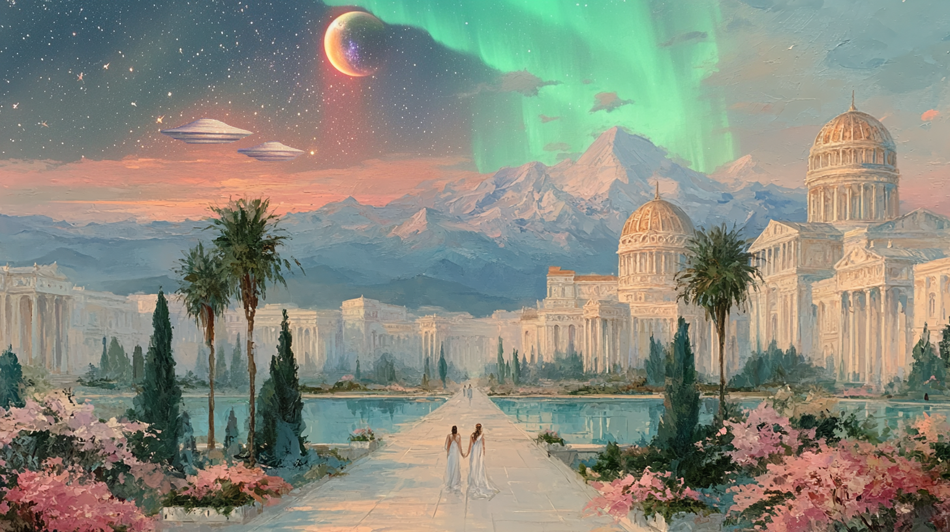
Antediluvian history means the history of Atlantis. After the Flood it becomes that of Hyperboreans, Celts and Egyptians.
No memory of the Hyperboreans remained after their disappearance, except that they were a sort of elite among white races, and that they lived at Thule, in the polar regions. They certainly vanished soon after the Flood, but, though they left a profound imprint of their mental and spiritual achievements on the civilizations of northern Europe, not a single material relic of them has ever been found, which leads one to think that they must have been a caste rather than a nation.
The ancient Greeks knew that they were Celtic in origin. It was in them that the Hyperboreans survived, even though for the last three thousand years they have been confused with Gauls and Brythons.
Hyperborea
Apart from a book on the Hyperboreans written by Hecate of Abdera, a Greek mythographer who flourished about the year 350 B.C., most of what we know of the Great Ancestors comes from Diodorus Siculus.
‘Hecate,’ he writes, ‘and some others assert that in the Ocean beyond the land of the Celts (northern Gaul) there is an island at least as large as Sicily.
‘This island, which lies far to the north, is inhabited by the Hyperboreans, so-called because they live beyond the north wind. The soil of this island is so good and so fertile that it yields two harvests every year…..
‘This where Latona was born, which explains why the islanders are particularly dedicated to the worship of (her son) Apollo…. They are all, one may say, priests of Apollo….
‘The Hyperboreans speak a language of their own. They are, and always have been, very friendly disposed to Greeks, and especially to Athenians and Delians.
‘It is even said that a number of Greeks have visited the Hyperboreans, taking splendid gifts with Greek inscriptions; and that in return Abaris of Hyperborea once made his way to Greece, to revive the ancient friendship.
‘It is also said that, seen from this island, the moon seems extraordinarily near the earth, so that the configurations of its surface are plainly visible.
‘Apollo is believed to visit the island once every nineteen years.
‘At the end of this period the stars in their courses have returned to the same relative position as they were at the beginning. This nineteen-year period is called the Great Year by the Greeks.
‘During the time of his descent upon earth, the god may be seen every night, from the Spring equinox until the rising of the Pleiades, dancing to the accompaniment of his cithara, as though to show his appreciation of the people’s worship.
‘Government of the island and the guardianship of the temple are in the hands of its kings, who are named Boreades, and who are the descendants of Boreas.’
The fact that Apollo was born of a Hyperborean mother, and that he held a preponderant position in Hellenic mythology, would of itself witness to the northern and Celtic origin of the early Greek Pelasgians.
Was Apollo An Extraterrestrial Being?
The end of Diodorus Siculus’ text might lead one to suppose that Apollo was merely a solar symbol.
True, like all the gods of antiquity he was represented by one of the heavenly bodies – the sun in this case – because it was the custom to show respect for a superior Being by likening him to a star. Apollo was not a myth, but probably one of the heroes, an Initiator from the North.
Among northern peoples and Scythians he was known as Abaris the Hyperborean, and he had the power of traveling about the cosmos on a flying arrow, like King Bran of the People of the Hills, who went from his country to the ‘Land Beyond’ with the speed of a jet. Like Manannan mac Llyr, the Irish wonder-worker, he navigated in space and regions of mystery, like Asshur, the Assyrian god, who was mounted on a winged bull; or Nin-Girsu the winged deity of Akkad and Sumer; Horus, the Egyptian, the Phoenician Astarte, Orejona, the Mother of the Incas, Quetzalcoatl, the winged serpent of Mexico – they all traveled through space, and were probably all extraterrestrial Initiators. There was also the Hindu Rama, who piloted his ‘spherical vimanas and traveled through the air by the power of mercury, which generated a strong propellant wind….’
None of these gods or heroes was an astral myth any more than was Apollo. In all mythologies and according to accounts given by ancient historians, they really moved about the skies in flying machines, which were generally depicted by Celts, Mayas, Incas, Assyrians or Egyptians like modern aeroplanes, flying saucers or space rockets.
Apollo’s arrow reminds one of a jet plane; Orejona is said to have used an airship ‘more dazzling than the sun’, which may have been propelled by the sort of ionized solar engine shown on the Gateway of the Sun; Quetzalcoatl knew the space-rocket engraved on the plaque at Palenque; Astarte had her mysterious flying serpent with its screw propeller; Asshur’s winged disc and the ‘eye of Horus’ soaring in the sky seem to have been actual flying saucers, and are much the same as the space ships used by Other-World men from Baavi, described by the ‘mysterious Mn.Y.’
In addition to Abaris, tradition gives the names of two other Hyperboreans – the virgins Argea and Opis – who introduced the Cult of Latona, Apollo and Diana to Delos.
On this point, J. Ponge-Helmer, a historian and scientific technician, recalls in one of his very interesting works the passionate desire of the Seleucid Kings of Persia to reintroduce the worship of the Hyperborean Virgin Laodice, and the Nazis’ aspiration to re-establish runic and solar myths.
Thule, The Gateway to…?
Tradition names the capital of Hyperborea as Thule, which in olden days was the extreme northern limit of the known world; whence its name Ultima Thule.
A sailor from Marseilles named Pytheas once undertook to go as far as possible north of Europe. He got beyond the British Isles, and discovered another island ‘which at the summer solstice had day but no night, and at the winter solstice night but no day!’ His contemporaries, even learned men, shouted with laughter – as if such a place could possibly exist!
Anyway, Pytheas came from Marseilles. And not even Athenians could beat a Marseillais when it came to travelers’ tales!
Other sailors and historians also had something to say about Thule, and it was successively sited in Iceland, the Shetlands, the Orkneys, Finland and Greenland, with the result that today no one would know where to look for it, if Hyperborean traditions – abominably misrepresented by Hitler in 1938 – did not give the necessary information.
Thule lay at the gateway to other worlds, the focus of earth currents. It acted as a decompression chamber, allowing transit from one sphere of life to another, from one universe to another.
The Hyperborean capital therefore occupied a position, which suggested a very interesting idea to Guy Tarade.
According to him, the North and South Poles were gates to the cosmos, in other words they were the two ports from which it was possible to leave the earth, the places where the Van Allen belts are inflected or modified, and where there are radioactive strata that can be highly dangerous to cosmonauts.
This was in fact what the Patriarch Enoch said when he went to the ends of the earth, to the place where ‘the gates leading to heaven’ were to be found, on his way to consult with the Early Fathers before the Flood. It is known that Enoch made interplanetary journeys, so that the Early Fathers; Initiators from Above, must have been cosmonauts.
These two gaps in the Van Allen belts, according to Guy Tarade, would be the points at which Initiators of those days arrived and departed. If these atomic belts were no longer there to protect us, the earth would be liable to a cosmic bombardment that might cause fearful upheavals. Fortunately, they are still in position, kept in place by the magnetic pull of the earth.
An alarm was raised at the Moscow Oceanic Congress in 1966 by the American physicists Heezen and Bruce. They had been studying what they called a fossilized compass found on the seabed, and from this they discovered that at some time the poles had been completely inverted, and that at present their magnetic strength was gradually diminishing. According to their calculations, it would not exist at all in two thousand years’ time, and a prolonged series of natural catastrophes would endanger the normal evolution of mankind and other living species on earth.
It may be that it was for some similar reason that an extraterrestrial humanity had many ages ago been obliged to emigrate, and that they had decided to settle at the North Pole for fear of further disasters.
Moreover, if Hyperborean space travelers had a knowledge of science superior to our own, as seems likely, they would have been in a position to inject into the nervous system of the globe – the earth currents – a force which could in a certain measure have influenced human behavior.
This is exactly what television is doing today – it is molding the psychological attitude of viewers according to the standards of each nation.
So the Hyperboreans may be said to have been the real Masters of the World by virtue of their geographical position.
An atomic war, described by both Hindus and Mayas, broke out between Hyperboreans and the eastern civilizers of the Land of Mu; the arena of battle was no doubt at the North Pole.
It is disturbing to realize that at the present day two great atomic powers, one situated partly on ancient Atlantis, and the other including much of the one-time Land of Mu, are contending for possession of the North Pole, where the largest city miraculously bears the name of Thule in this twentieth century.
The earth too has its memory-chromosomes, and what has been will recur, exactly as before.
 Celts Were Seafarers
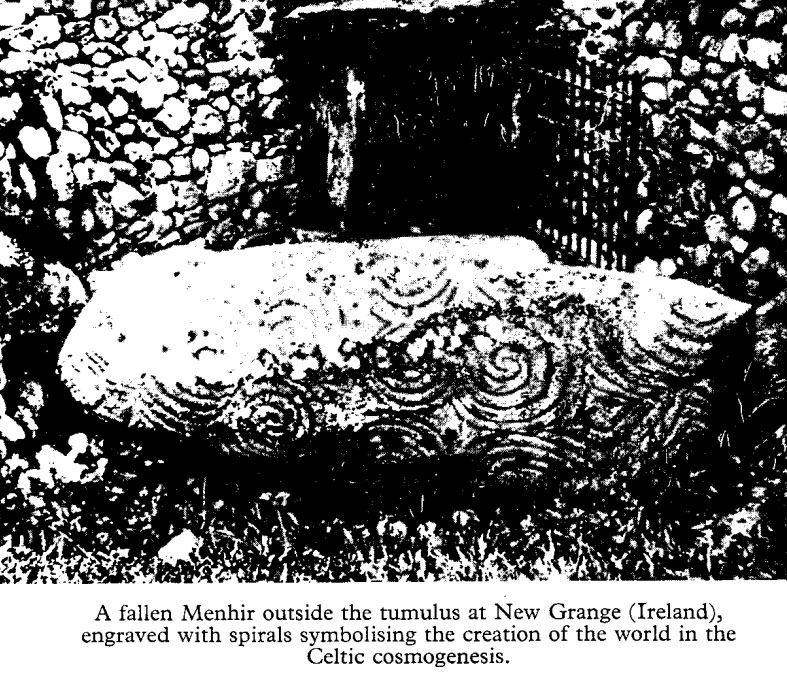
Archaeology and tradition show that the Hyperboreans and their direct descendants the Celts were certainly colonizers from very ancient times and that they dominated the whole world intellectually. The Celts, descendants of the Thule caste, were distinguished by their exceptional qualities as seafarers.
They emigrated to North, South and Central America, infiltrated Polynesia and took possession of all the lands surrounding the Mediterranean basin. The Pelasgians, whose name implies that they came from northern seas, were the ancestors of the Greeks, the Phrygians and the Phoenicians, worshipers of Apollo, Baal-Bel and sacred stones; they raised megaliths in the shade of an oak tree or upon the slopes of Mount Ida (which is itself a typically northern name).
Torridans, Nuraghians, Sardi, Hyksos and other seafaring peoples, wearing the ritual horned morrions, settled in Corsica, Sardinia and Egypt.
Phoenician ships sailed far beyond the Pillars of Hercules, and it is interesting to find that the outstandingly maritime peoples – Icelanders, Irish, Brythons (English), Norsemen, Bretons, Basques, Spaniards and Portuguese – are all of pure Celtic descent, and live in countries where tumuli and menhirs abound.
Neither the black nor the yellow races seem to have had the temperament nor the desire to become sailors or pioneers. They were stay-at-homes, while Celts were migratory, driven by memory-chromosomes inherited from their space traveling ancestors.
The purer-blooded the Celts were, the more they tended to be wanderers, ‘sea-people’. So it was always the maritime nations who colonized the rest of the world. This is the reason why Egypt, one of the largest of empires, never succeeded in spreading its civilization far afield, but on the contrary suffered one invasion after another, that of the Hyksos having the greatest consequences.
Excerpt from The Mysterious Unknown
To continue reading see full pdf download here.

Related posts:

Posted in Other Topics, True History of Manwith comments disabled.