
Why We Can’t Be Alone
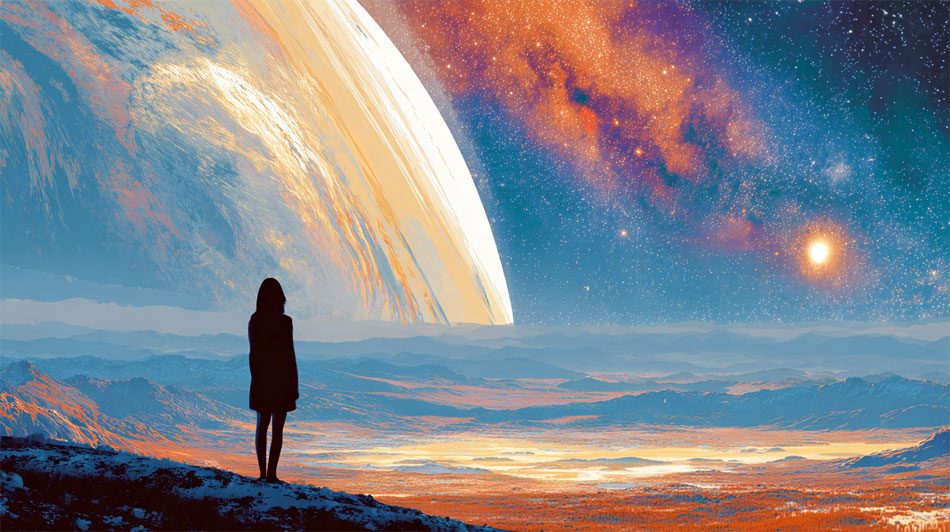 Why The Sheer Size Of The Universe Suggests We Are Not Alone
Human beings evolved on a small rocky planet orbiting an ordinary star in the outer regions of an average galaxy. Yet when we lift our eyes to the sky, we are confronted with a reality so vast that it challenges intuition, philosophy, and probability itself. One of the strongest scientific arguments against the idea that humanity is alone in the universe is not based on speculation about aliens, mysterious sightings, or science fiction – it is based on scale. The universe is staggeringly, incomprehensibly large. And within that immensity lies the statistical case that life, intelligent life, is unlikely to exist only once.
To grasp this argument, we must begin with the most fundamental fact: the universe is vast beyond ordinary human comprehension. The observable universe – the region from which light reaches us – is estimated to be about 93 billion light-years in diameter. That alone is difficult to visualize. A single light-year is the distance light travels in a year – roughly 9.46 trillion kilometers. Multiply that by 93 billion, and we are no longer dealing with distances that human language easily conveys.
And this is only the observable universe. Beyond it may lie regions forever hidden from us due to cosmic expansion. The total universe could be far larger – perhaps even infinite. Astronomers emphasize that we speak only of what we can observe; what exists beyond that boundary remains unknown.
Within this observable universe are galaxies – vast collections of stars, dust, gas, and dark matter bound together by gravity. Early estimates suggested hundreds of billions of galaxies. More recent observations indicate that the number may reach into the trillions.
Each galaxy contains its own stellar population. Our home galaxy, the Milky Way, contains roughly 100 to 400 billion stars. Multiply that by trillions of galaxies, and the number of stars becomes almost inconceivable.
Astronomers estimate that the observable universe may contain on the order of 10²² to 10²⁴ stars – that is, sextillions to septillions of suns. Numbers at this scale are difficult to interpret. They exceed the number of grains of sand on Earth’s beaches.
The late astronomer Carl Sagan captured this sense of scale when he observed:
“There are… 100 billion galaxies, each… 100 billion stars.”
Such numbers are not poetic exaggerations – they are rooted in astronomical measurement and statistical modeling.
The modern era of astronomy has dramatically expanded our understanding of cosmic scale. Telescopes such as Hubble and the James Webb Space Telescope have revealed galaxies that formed billions of years ago.
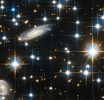
Recent deep-field observations have mapped hundreds of thousands of galaxies in small regions of the sky, implying that the full universe contains far more than early astronomers imagined.
In one deep survey, astronomers used Webb data to observe a field containing roughly 800,000 galaxies – within a region only a few times the size of the Moon in the sky.
Each of those galaxies is itself a cosmic ecosystem, filled with stars, planets, and dynamic physical processes. And this observation represents only a tiny fraction of the sky.
Stars, Planets, and Cosmic Probability
Stars are not rare; they are the most common visible structures in the universe. And around many stars orbit planets. The discovery of exoplanets – worlds beyond our solar system – has revealed that planetary systems are the rule, not the exception.
If each star has even a small chance of hosting habitable conditions, the sheer number of stars dramatically increases the probability of life emerging elsewhere.
Consider the arithmetic:
- Trillions of galaxies.
- Hundreds of billions of stars per galaxy.
- Potentially billions of planets within each galaxy.
Even if life arises only under rare circumstances, cosmic scale means that “rare” does not equal “unique.”
Time: The Universe’s Hidden Dimension
Space is not the only factor. Time also plays a crucial role. The universe is approximately 13.8 billion years old. That is more than three times the age of Earth.
Many stars and planetary systems formed billions of years before our Sun existed. Life elsewhere could have had enormous stretches of time to arise, evolve, and develop intelligence.
On Earth, life began relatively quickly once conditions stabilized. That suggests biological processes may emerge naturally when environments allow.
If this pattern holds elsewhere, then life may have appeared across the cosmos countless times over cosmic history.
The universe is not random chaos; it has structure. Galaxies cluster into filaments and vast cosmic webs stretching millions of light-years. Recent observations have detected enormous rotating structures composed of hundreds of galaxies moving together through space.
These structures show that the universe operates on scales far beyond individual stars or galaxies. Matter flows, clusters, and evolves across immense distances.
This structure matters for life because it implies shared physical laws and recurring patterns. Where the laws of chemistry and physics repeat, similar outcomes – including life – may also repeat.
Matter: A Tiny Fraction of Reality
Another humbling fact is that everything visible – stars, planets, galaxies, and people – makes up only a small fraction of the universe’s total mass-energy. Normal matter accounts for roughly 5%, while dark matter and dark energy dominate the rest.
Even within that 5%, most ordinary matter is not inside stars or planets but scattered between galaxies.
This means the cosmic environment is vastly richer and more complex than the visible structures alone suggest.
Life may arise in ways we do not yet fully understand, perhaps in environments very different from Earth.
History repeatedly teaches the same lesson: humanity is not at the center. Earth is not the center of the solar system. The Sun is not central to the galaxy. Our galaxy is not central to the universe.
Each scientific breakthrough moves us further from a privileged cosmic position.
If our location is not special, why should our biology be?
The principle that Earth is not unique – sometimes called the Copernican principle – suggests that what happened here may happen elsewhere.
The argument from cosmic size is not emotional – it is statistical.
Imagine flipping a coin once and getting heads. That result tells you little. But flip the coin a trillion times, and patterns emerge.
Similarly, if there were only one planet in the universe, life would be astonishing. But with trillions of galaxies and sextillions of stars, the probability landscape changes dramatically.
Rare events become inevitable when the number of opportunities is large enough.
Even if the chance of life forming on a planet were extraordinarily small, cosmic scale provides enough “attempts” for life to arise many times.
The human brain evolved to navigate landscapes, not galaxies. We struggle to grasp large numbers.
Astronomers often compare the number of stars to grains of sand on Earth because such comparisons help translate cosmic magnitude into relatable terms. Even then, the analogy falls short.
The universe is not just large – it is staggeringly beyond everyday comprehension.
And within that scale lies a simple logical conclusion: uniqueness becomes statistically unlikely.
Philosophical Implications
If the universe contained only one instance of life, it would imply that Earth is an extraordinary anomaly – a singular miracle amid a cosmic ocean.
But science typically finds that nature favors repetition, not singularity. Atoms form everywhere. Stars ignite everywhere. Galaxies assemble everywhere.
Why should life be different?
This does not mean life must be common. It does not guarantee intelligent civilizations exist. But it shifts the burden of proof. The question becomes not “Why would life exist elsewhere?” but “Why would it exist only here?”
Every decade, our picture of the universe grows.
New telescopes reveal earlier galaxies, more planets, and deeper structures. Observations continue to increase the known number of cosmic objects.
What once seemed rare often turns out to be abundant.
Planets were once thought exceptional; now they are known to be ubiquitous. Galaxies once seemed countable; now their number expands with each new survey.
This pattern suggests that the universe is richer than we imagine – and that life may be part of that richness.
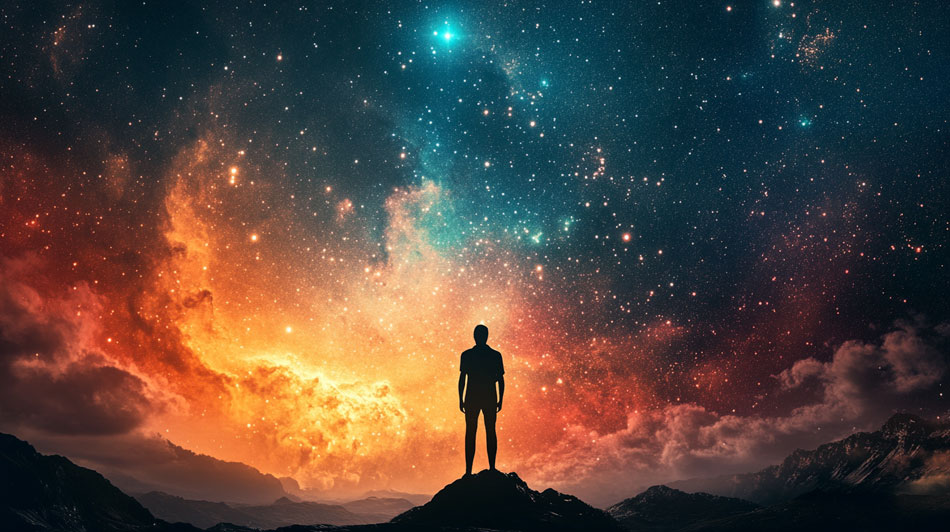 Conclusion: Cosmic Scale
The immensity of the universe does not prove extraterrestrial life exists. Science requires direct evidence.
But scale changes probability.
When confronted with trillions of galaxies, sextillions of stars, and billions of years of cosmic history, the idea that life emerged only once becomes increasingly difficult to defend statistically.
The universe is not a small, empty stage with a single actor. It is a vast cosmic arena filled with possibilities.
And in a universe this large, the emergence of life – perhaps many times, in many forms – may not be the exception.
It may be the norm.

Related posts:

Posted in Life On Other Worlds, Other Topicswith no comments yet.
Leave a Reply