
Is 3I/Atlas Artificial Probability At Nearly 100%
 Introduction: The Visitor That Broke the Rules
Our solar system occasionally plays host to visitors from the vast emptiness between the stars. These interstellar objects offer a rare glimpse into the chemistry and physics of other star systems. But the latest visitor, an object designated 3I/Atlas, is proving to be more than just a cosmic messenger. While initially classified as a comet, it has begun to exhibit behavior that deeply puzzles astronomers and challenges our fundamental understanding of natural celestial bodies.
As 3I/Atlas made its closest approach to our sun, it started to move in ways that defy a simple cometary explanation. Now, new images have provided what some are calling a “smoking gun – a startling piece of evidence that makes the natural explanation increasingly unlikely. This article breaks down the latest takeaways from this developing cosmic mystery, revealing a pattern of strangeness that points toward an extraordinary conclusion.
 The Engine Without Exhaust: A “Smoking Gun” Anomaly
The central puzzle surrounding 3I/Atlas is its “non-gravitational acceleration” (NGA). In simple terms, this means the object is changing its speed and trajectory for reasons other than the pull of gravity. For a typical comet, this is perfectly normal; as the sun heats its icy surface, gas and dust erupt, pushing the comet like a tiny, chaotic rocket. But 3I/Atlas has taken this to an unprecedented level.
The object has shown more NGA than any natural comet in recorded history at its distance from the sun. To achieve this acceleration, models suggest it would have had to explosively shed over 13% of its total mass – a staggering 3 to 4 trillion kilograms of gas and dust. Such a colossal eruption should produce a spectacular visual display: a massive, hazy cloud (a coma) between 10,000 and 100,000 kilometers long and a brilliant tail.
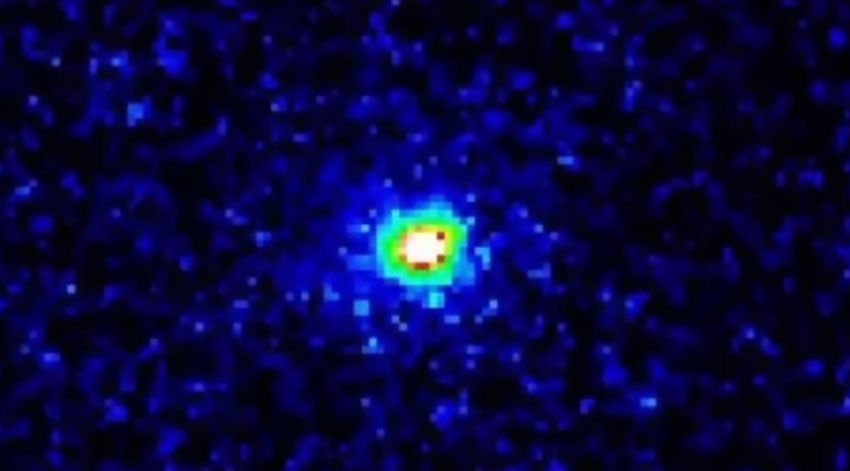
And yet, recent images from November 5th show the exact opposite. They reveal a compact, point-like source of light with no visible coma or tail. This is in stark contrast to other comets, like Comet Lemon, which clearly displays a prominent tail under similar observation. The engine is firing, but there is no exhaust. This paradox led astronomer Avi Loeb to a stark conclusion:
“The absence suggests propulsion other than cometary evaporation, potentially an engine. It’s the strongest evidence yet against a typical comet pushing for urgent high-resolution data…”
The missing tail is not an isolated incident. It is the latest and most glaring entry in a long list of bizarre characteristics that make 3I/Atlas stand out from any natural object we have ever seen. When viewed together, they paint a picture of an object that seems to consistently break the rules
Unusual Orbit: Its path is suspiciously aligned with the plane of our solar system’s planets (a 2% likelihood). Its arrival was also timed for close flybys of Mars, Venus, and Jupiter, and to be unobservable from Earth at perihelion – a timing coincidence with a 0.005% likelihood.
Extreme Mass and Speed: Its nucleus is about a million times more massive than Oumuamua, yet it moves faster than both Oumuamua and 2I/Borisov, our other known interstellar visitors. The likelihood of such a massive object moving this fast is less than 0.1%.
A Sunward Jet: At one point, it displayed an “anti-tail” – a jet of material pointing directly towards the sun, an observation unlike any other comet.
Strange Chemistry: Its gas plume contains much more nickel than iron, similar to industrial alloys, and its nickel-to-cyanide ratio is orders of magnitude larger than any known comet. It also contains only 4% water by mass, whereas water is a primary ingredient of most comets.
Unprecedented Brightening and Color: Near its closest approach to the sun, it brightened faster than any known comet and was observed to be bluer than the sun itself.
Weird Light Signature: The object showed a “negative light polarization,” a trait never before seen in a comet. This signature suggests its shape is more like a Centaur – a class of asteroid-like objects in the outer solar system – than a typical comet.
Coincidental Origin: It arrived from a direction in the sky that is coincident with the location of the famous “Wow!” signal, a powerful, unexplained radio signal detected in 1977.
The 40-Trillion-to-One Problem
With so many low-probability anomalies piling up, what are the odds that 3I/Atlas is just a one-of-a-kind natural fluke? To quantify this, the AI model named “Grok” was tasked with performing a Bayesian analysis, calculating the probability of all these strange characteristics occurring together in a single natural object.
The result was astonishing: the odds against a natural explanation were calculated to be 40 trillion to one. This number translates to a 99.9999975% chance of the object being artificial.
It is crucial to include an important caveat. As analysis noted, this is a purely mathematical calculation based on the known data. It doesn’t account for what may be the single largest factor: the extreme unlikelihood of an artificial object entering our solar system at random, something that has never happened before, at least to our knowledge. Therefore, while the 99.9% figure might be an overstatement, the sheer, staggering improbability of the natural explanation is a data point that cannot be ignored.
The Perfect Imperfection: Is It a Disguise?
A common skeptical argument has emerged: “If it were an advanced alien probe trying to hide, why is it doing such a bad job, with so many obvious anomalies?” The object’s strange behavior seems counter-intuitive if the goal is stealth.
However, a counter-argument rooted in concepts like the “Dark Forest hypothesis” – the idea that advanced civilizations hide to avoid detection by potentially hostile ones – suggests the disguise is actually fantastically effective. Despite the mountain of bizarre evidence, over 90% of professional astronomers still insist that 3I/Atlas must be a natural object. This leads to the “imperfect disguise” theory: the object isn’t trying to be a perfect copy of a comet, but rather one that is just good enough to maintain plausible deniability.
By masquerading as a natural object – even a strange one – it could fool a civilization that might be biased or “narrow-minded” about what a technological signature looks like. The goal might not be a perfect disguise, but one that is good enough to allow it to complete its mission while the locals argue about whether it’s even worth a closer look.
Conclusion: A Question Hanging in the Void
No one is claiming that 3I/Atlas is a “giant flying saucer” or a star destroyer straight out of science fiction. But the accumulation of evidence – crowned by the new “smoking gun” of powerful acceleration with no visible exhaust – makes the conventional comet explanation incredibly difficult to maintain. While the object shows a faint, stable coma, this feature is entirely inconsistent with the violent, multi-trillion-kilogram eruption required to explain its change in trajectory.
As 3I/Atlas continues its journey back into the interstellar void, it leaves us with a profound question. What if the greatest discoveries aren’t found by looking for things that fit our expectations, but by paying close attention to the ones that break all the rules?

Related posts:




Posted in Other Topics, UFOswith comments disabled.